Bharathan Mudaliar
The Dharma System, Reverse Engineered
I'm a thorough generalist and an avid reader — behavioral economics, detective fiction, popular finance, history, and anything else within reach. What ties it together is a long-standing fascination with the human mind: how it actually functions, how it responds to different situations, and the persistent gap between how rationally people think they behave and how they actually do. That fascination, taken seriously across enough books and enough time, eventually leads you somewhere unexpected. In my case, it led here.
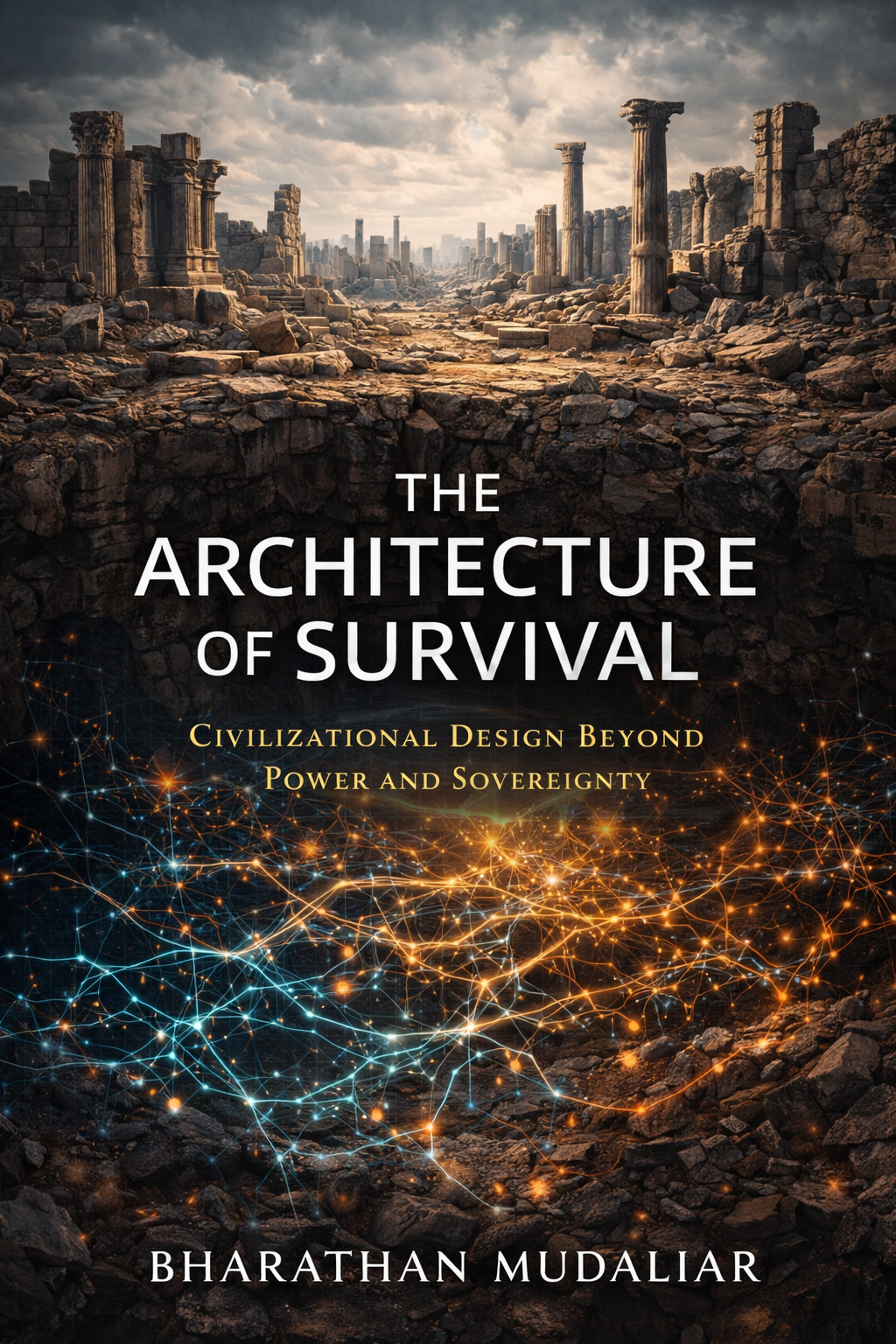
The Architecture of Survival
Civilizational Design Beyond Power and Sovereignty
The Architecture of Survival examines why civilizations often persist even when centralized political authority collapses. Across history, regimes fail frequently, yet many societies continue to reproduce social order, legitimacy, and coordination long after sovereignty fragments or disappears. The book begins from this puzzle and investigates the structural assumptions that allow some civilizations to endure conditions that dissolve others.
The framework is developed through comparative case studies across long historical horizons, including Rome, India, China, Japan, the Jewish diaspora, and more. These cases are used not as narratives of rise and fall, but as stress tests to examine how social order persists when political authority fractures or reconfigures.
Following this question reveals a recurring contrast. In some civilizations, order depends heavily on centralized command, rising and falling with the state itself. In others, order is carried more diffusely, allowing coordination to persist even when sovereignty weakens or disappears. The book treats these as alternative architectures for solving the same problem under different constraints.
Rather than arguing for a particular system or outcome, the book proceeds by following a simple question wherever it leads: why does order sometimes survive the collapse of power? It moves back and forth between concrete historical cases, testing familiar assumptions about authority, coordination, and stability, and showing how different civilizations solve the same problem in strikingly different ways.
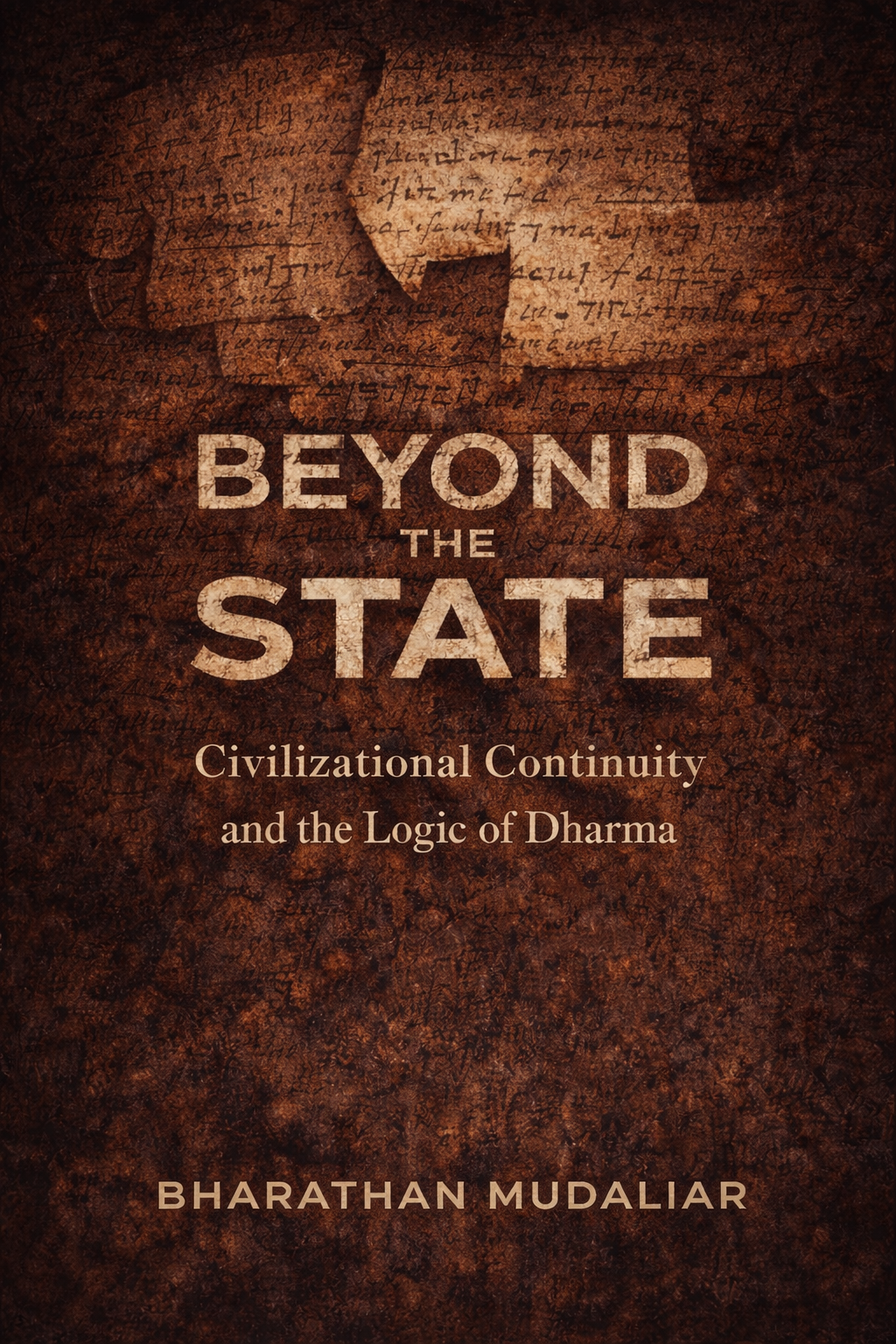
Beyond the State
Civilizational Continuity and the Logic of Dharma
Beyond the State examines why some civilizations dissolve when centralized political authority collapses, while others persist socially, culturally, and institutionally across centuries of fragmented or absent sovereignty. Rather than treating the state as the primary container of civilization, the book argues that continuity depends on deeper architectural assumptions about where order resides, how it is enforced, and how obligation is distributed across society.
The book develops a general analytical distinction between two civilizational models. In the Command Model, order is centralized, legible, and enforced through political power; when the state fails, civilizational coherence often fails with it. In contrast, the Dharma Model embeds order within social, religious, and economic life, making governance fragile but continuity resilient. Political authority may fragment or disappear, yet the civilization persists.
Drawing primarily on long historical time horizons and internal civilizational logics, Beyond the State treats traditions not as cultural artifacts but as functional “source code” for social organization. The concept of dharma is analyzed not as theology or moral philosophy, but as an organizing principle that distributes responsibility, legitimacy, and norm enforcement beyond formal institutions.
The book is deliberately abstract and historical in scope. Its purpose is analytical—to clarify the structural trade-offs that shape continuity, collapse, and survival across civilizations.
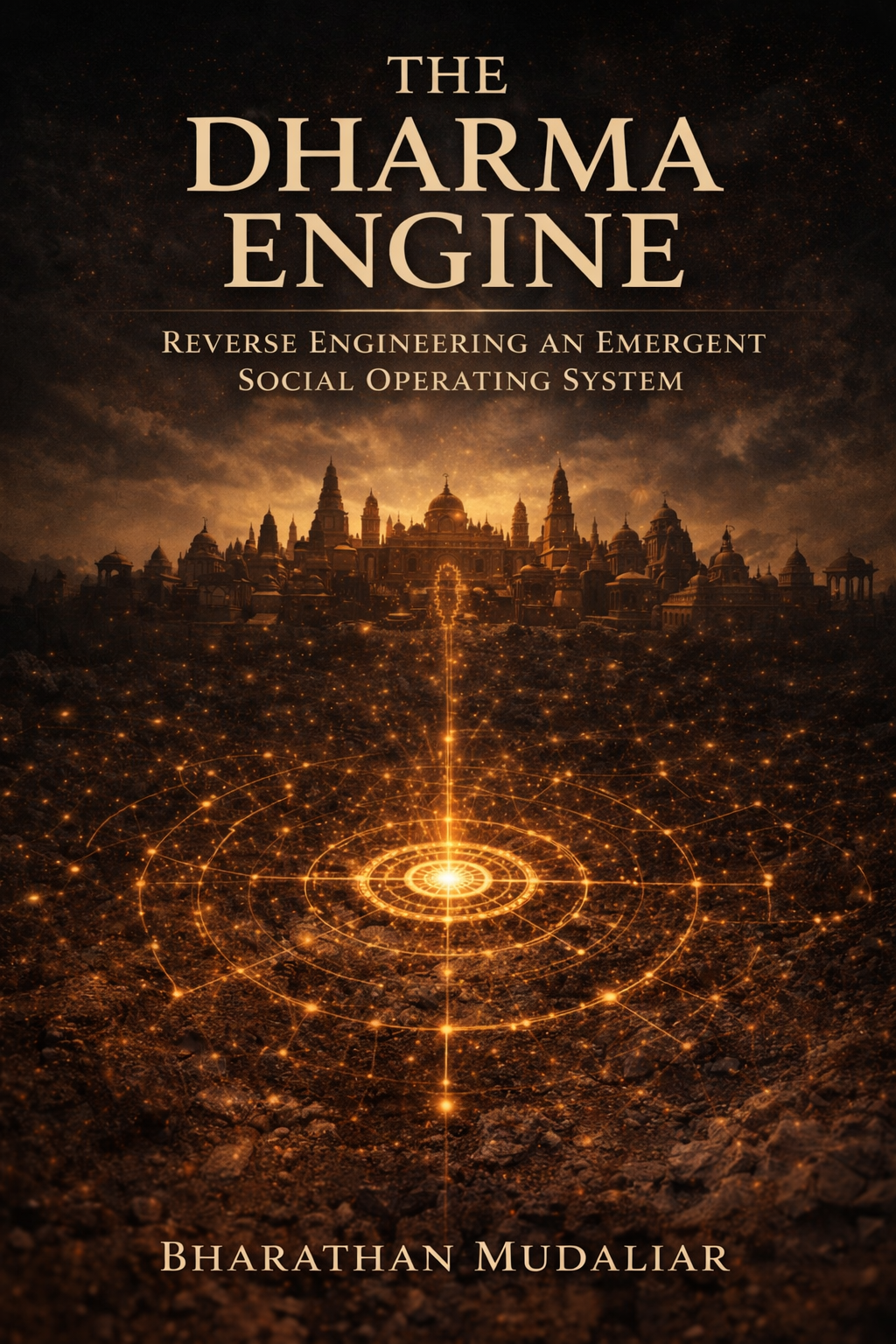
The Dharma Engine
Reverse Engineering an Emergent Social Operating System
The first two books identified the pattern. This one opens the panel and looks at the wiring.
The Dharma Engine asks a precise question: how does the Dharma system actually work? Not as philosophy, not as belief, not as cultural heritage — but as a functional architecture for solving the hardest problem in social organization. How do you get millions of independent nodes to cooperate, maintain trust, and correct failure, without a central authority enforcing any of it?
The answer turns out to be a sophisticated interlocking system of game theory dynamics, self-regulating feedback loops, and distributed enforcement mechanisms — assembled not by design, but through millennia of trial, failure, and adaptation.
The book reverse-engineers that system layer by layer, using the tools of systems thinking and game theory to make explicit what the tradition has always known implicitly.
The Dharma Engine is currently being written. The ideas are being developed in public at The Dharma Engine Substack — one essay at a time, at whatever pace the thinking deserves.
Methodology
I have read the Mahabharata countless times—for the same reason people reread Harry Potter: for the pleasure of sprawling characters and endless sub-arcs.
As a thorough generalist, I eventually began noticing patterns. What stood out was how the epic treats human behavior and its failure modes with striking rationality—especially in situations involving authority, obligation, and breakdown. This led me to ask what it would mean to take the internal logic of dharma seriously, not as philosophy or belief, but as an operating system.
To see whether these patterns were merely literary or civilizationally specific, I compared them against other normative and technical texts and against historical cases across long time horizons, spanning multiple civilizations. Indian sources were treated alongside material from non-Indian contexts, including societies with very different religious, legal, and political foundations.
History was treated as a form of stress-testing: not as illustration, but as a way to see whether the patterns identified in textual edge cases actually describe how societies behave under political strain. The two books so far grew out of this process.